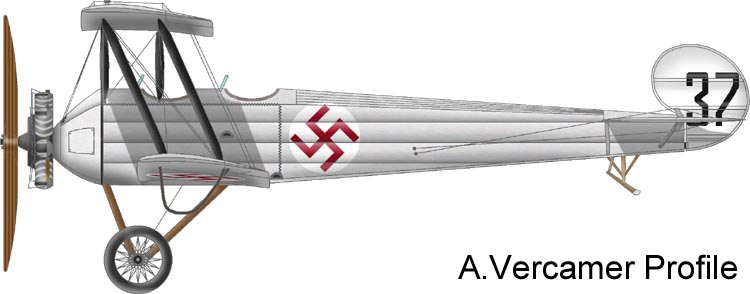
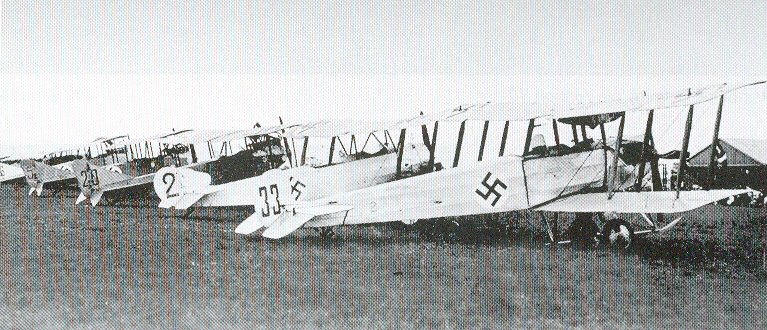
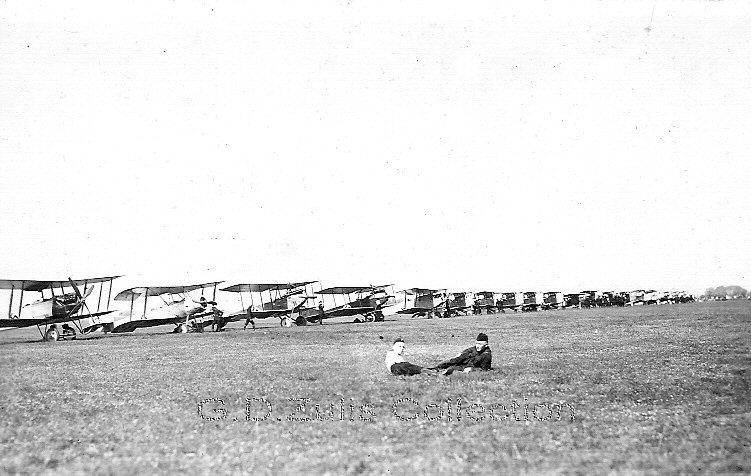
Engine: 80 hp Renault (#32, 33), the two 504Ks used (at
various times) either the 100 hp Gnome or the 130 hp Clerget)
Dimensions
Length: 8.97 m
Wing Span: 10.97 m
Height: 3.2 m
Max Speed: 120 km/hr
Range: 360 km
Maximum Ceiling: 3000 m
Known Serial Numbers: 32, 33, 36, 37, 2 (Aizsargi),
5 (Aizsargi), 6 (Aizsargi).
Notes
The Latvian military treated the 504K and 548N as much the same aircraft,
using them in the same training role and, where possible, interchanging the parts.
These durable aircraft served in the Latvian air force and, later, the Aizsargi
until 1936.
1927-1928 - the latvian military considers building their own Avros in the AS Christine
Backmane workshop, but the British were demanding so much payment in exchange for the
license to build these that the plan was dropped. The Udet Flamingo was built instead.
1930 - the Avro trainers are replaced by the Flamingos as the dominant air force trainers.
1930 - one of the old Avro 504 engines (80-hp Renault) is purchased
by Herberts Cukurs and installed into his C.3
1933 - the military gives the Aizsargi their three remaining Avros.
#32
Avro 548N (original serial no.16874)
December 16, 1924 - test flown and accepted. (Jakubovs)
January 28, 1928 - crash (Steinbergs)
March 1, 1928 - Flight instructor J.Indans, with student A.Strautnieks, spins the aircraft
heavily into the ground. Both airmen survived but Indans suffered multiple injuries.
July 12, 1930 - Lost a wheel on takeoff. (Trejs, Salenieks)
#33
Avro 548N (original serial no. 16891)
December 16, 1924 - test flown and accepted. (Jakubovs)
1925 - Nikolajs Bulmanis, in Avro #33, successfully completes his flight test.
It was with this aircraft that designer Nikolajs Pulins completed his first solo flight.
1928 - rebuilt, replacing the 80 hp Renault with the Siemens Sh12
August 3, 1929 - collapsed upon landing (Mellups)
July 28, 1930 - engine failed in flight, forced landing. (G.Jekabsons)
September 18, 1930 - crash (Meijers/Veldre)
#36
October 29, 1925 - test flown and accepted. (Zarins)
1926 - after major repairs, test flown and returned to service. (Pukse)
May 22, 1930 - engine failure forced a downwind landing, aircraft flipped over (Eglitis)
June 8, 1931 - crash (Krastins)
#37
October 29, 1925 - test flown and accepted. (Zarins)
1928 - Rebuilt, replacing the original engine with the Siemens Sh12
May 16, 1930 - engine fails on takeoff resulting in a crash (Trejs, Penks)
1933 - the military hands over its three remaining Avros to the Aizsargi, where
they receive new serial numbers.
September 8, 1934 - heavy crash. The engine failed near Lubana, necessitating a forced landing.
Upon striking the ground, the fuselage broke its back. (Teikmanis)
#5 (Aizsargi)
1933 - the military hands over its three remaining Avros to the Aizsargi, where
they receive new serial numbers.
Sept.11, 1935 - two airmen die in a heavy crash. Their engine had failed and they were
preparing for a forced landing. In the final turn before touching down the aircraft stalled
and fell into an irrecoverable spin.
#6 (Aizsargi)
1933 - the military hands over its three remaining Avros to the Aizsargi, where
they receive new serial numbers.
Sources
- Bruce, J.M. British Aeroplanes 1914-18
- Bruvelis, Edvins Latvijas Aviacijas Vesture
- Holmes, Harry Avro
- Humberstone, R (ed) Latvian Air Force 1918-1940
- Jackson, A.J. Avro Aircraft since 1908
- Jane, Fred T. Jane's All the World's Aircraft 1919
- Windsock Datafile #28 (Avro 504K)