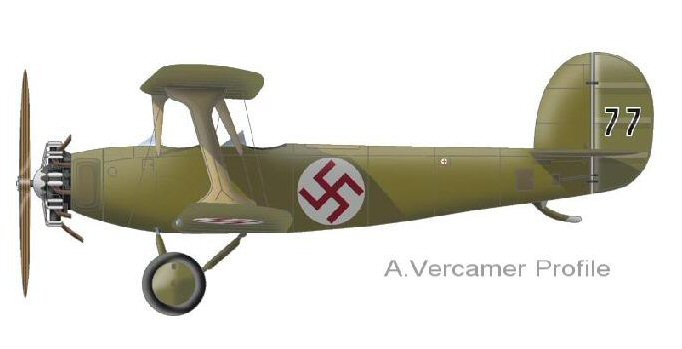
Source: Built under contract at the Kristina Bakmane factory, construction completed at the Arsenals factory
and in the Air Force workshops (#s 95 and 96).
Acquired: 1930
Type: trainer
Engine: 110 hp Siemens Sh12, 9-cylinder radial
One machine (#77) was experimentally re-engined with the Czech 145hp Walter Mars radial engine.
Dimensions
Length: 7.4 m
Wing Span: 10 m
Height: 2.8 m
Max Speed: 145 km/hr
Range: 450 km
Maximum Ceiling: 3800 m
Known Serial Numbers: 76, 77, 86, 87, 89, 95, 96.
Aircraft with civil registration numbers YL-ABX, YL-ABW and YL-ABY were flown by the Latvian Aeroclub flight school.
Notes
Built from a 1925 German design
An excellent training machine, with a slow landing speed and few 'vices'.
Equipped with dual controls for the training function, with the instructor sitting in the front and the student behind.
1927 - two German pilots from the Bayerische Flugzeugwerke demonstrate the U-12 Flamingo
in Latvia. [Irbitis] Note: [van Ishoven] states the demonstration flight took place in Summer, 1928.
Originally the latvian military was considering building Avro trainers, but the license fees
being demanded were excessive and this idea was dropped. Building a locally designed trainer
at A.S.Christine Backman seemed to be the next best solution, until the Udet Flamingo was seen
on the demonstration flights, when it immediately became the trainer of choice.
Summer, 1929 - A.S.Christine Backman obtains a contract to build 10 U-12bs and a complete
set of plans is provided by BFW.
While Latvian manufacturers had no difficulty with the wooden parts (Latvian pine and birch plywood
were quite suitable) they initially had to buy some of the Duralumin parts from BFW. However, the
aircraft completed by the Aviation Regiment Workshops had the parts produced locally.
The Hugo Heine propellers, instruments and wheels were ordered directly from their German manufacturers.
Autumn, 1929 - A.S.Christine Backman begins construction of the U-12 Flamingos at their
new facility in Bisumuiza, a suburb of Riga.
Summer, 1930 - the Flamingo aircraft are completed and delivered to the Military Aviation School.
July 25, 1930 - the Flamingo aircraft are flown for the first time by the Military. The pilots were
the recent graduates of flight school - Jenkevics, Ozolins, Grave, Sapratnieks, Sleiters and Krastins.
Markings: "Some of the Latvian Flamingos were clear varnished, carrying a black number on their
silver rudder, while others were dark green overall with a white outlined black number on the rudder."
1936 - two of the Flamingos are modified to accept a full blind-flying panel and fitted with a
hood over the rear cockpit to make them suitable for instrument flight training.
1936 - in an effort to standardize aircraft types by code, the Flamingos as designated as type A-1.
The last of the Flamingos were still flying in the spring of 1940, where they were being
utilized as Aeroclub trainers and were training the 5th graduating class at Kalnciems (they had
been gifts from the Aviation Division).
After the Soviet occupation, all (or most) of the Flamingos were destroyed when the building
in which they were stored caught fire and burned to the ground.
# 76
August 4, 1930 - crashed (pilot: vltn. Lakstigala)
April 30, 1931 - crashed (pilot: Goldbergs)
June 16, 1931 - crashed (pilot: ltn. Peculis)
# 77
this aircraft was experimentally fitted with the Czech Walter Mars 145-hp radial
engine, but it was later replaced with the standard SH12.
August 12, 1930 - crashed (flight instructor vltn.Trejs with student, Salmins)
# 86
Sept. 15, 1930 - crashed (pilot: Nikolajs Balodis)
# 87
June 2, 1931 - crashed (pilot: Greizis)
August 31, 1931 - crashed (pilot: Bungss)
# 89
May 31, 1931 - flown by J.Indans in the Aviation Festival at Riga/Spilve.
1935 - the Aviation Division workshops builds an additional Flamingo, assigned the number 95.
July 1, 1935 - #95 is test flown and approved by capt. A.Dzenitis.
November 4, 1935 - midair collision with Bristol Bulldog #81. Three fatalities. This was
the only fatality associated with the Flamingo, which is a remarkable record considering its role
as a primary trainer.
Sources
- Andersons, Edgars Latvijas Brunotie Speki un to Prieksvesture
- Briedis, Emils Latviesa Stasts
- Bruvelis, Edvins Latvijas Aviacijas Vesture
- Humberstone, R. (ed) Latvian Air Force 1918-1940
- van Ishoven Udet (BFW) U-12 Flamingo Variants (Aircraft Profile #257)