INTERNATIONAL AFFAIRS
- On August 23, 1939 Germany and the Soviet Union signed the Molotov-Ribbentrop pact. At the heart of this
agreement was a secret protocol in which the two nations divided Eastern Europe into their two spheres of "influence".
Although the agreement underwent some ammendment, the final version left the Baltic nations in the zone assigned
to the Soviets. This gave the Soviet Union a free hand to operate with the Baltic nations in whatever manner they
wished without fear of German military response. The agreement operated as intended for almost two years.
- In late September, 1939, the Estonian Foreign Minister was summoned to Moscow ostensibly to negotiate
trade agreements, where instead he was presented with a Soviet demand for military bases in Estonia. The
threat backing up this demand was obvious and, after consulting with his government, the Foreign Minister felt
he had no choice but to acquiesce. The agreement claimed to recognize Estonian sovereignty, and provided
for the establishment of the military bases according to a 10-year lease.
- Latvia was pressured into a similar agreement on October 5, 1939. While the Latvian Foreign Minister went
to Moscow, the Soviets massed six Russian divisions along the Latvian border to ensure that the Latvians understood
the nature of their bargaining position. Under the terms of that agreement the
Soviet Union would occupy the Latvian military bases at Liepaja and Ventspils and also take up a position at
Pitrags on the tip of the Kurzeme peninsula. The terms of the document permitted the Soviet Union to base
up to 30,000 troops on Latvian soil. (Note: the Latvian military, in peace time, consisted of about 20,000 troops in total.)
- The Lithuanians were pressured into signing a similar agreement with the Soviets on October 10, 1939.
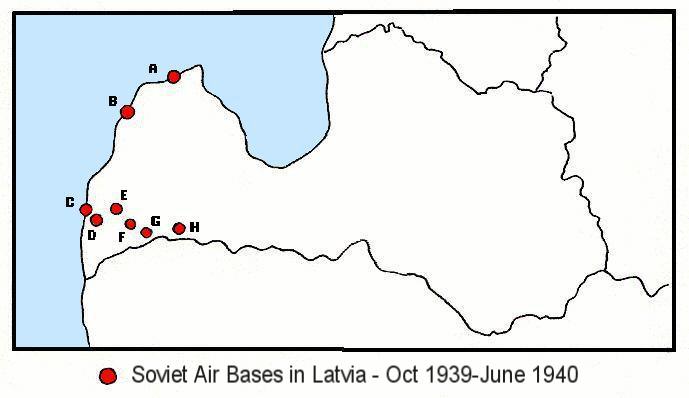
A - Pitrags
B - Ventspils
C - Liepaja
D - Grobini
E - Durbe
F - Priekule
G - Vainode
H - Ezere
THE BASES
- October 12, 1939 - a committee is formed to oversee the transfer of the bases to the Soviets, as per the Oct.5 document.
- October 23, 1939 - the plan for the transfer of the bases is agreed upon, and the Latvian 8th Reconnaissance Squadron
at Liepaja, under the command of Capt.K.Ercums, is given two days' notice to vacate their base.
- October 25, 1939 - Ltn.A.Lidaks leads the remaining Latvian naval aircraft - He4 #97, Fairey Seals # 98, 99, 100, 101 as they transfer to Kisezers,
a lake NNE of downtown Riga. The last remaining Svenska Pirat, in need of minor repairs, transfers to Riga/Spilve.
- October 29, 1939 - the first Soviet troops appear in Liepaja. The Soviets also occupied Liepaja's 'north' aerodrome, in Velciems.
- In Ventspils the Latvian Aero Club was required to surrender their airfield to the Soviets.
- From October 1939 onwards, Latvian flights in the vicinity of Liepaja - Durbe, Edole, Priekule, Ezere (where the Soviets were building an
air base), Vainode, and Ventspils were greatly restricted. The Soviets also built an aerodrome at Liepaja-Grobin which was later
used as a training base during the German occupation.
- this, essentially, remained the state of affairs until the Soviets completed their occupation of Latvia in June, 1940.
Sources
Bruvelis, Edvins Latvijas Aviacijas Vesture
Krastins, K. Latviesu lidotaji 2. pasaules kara in Daugavas Vanagu Menesraksts, 1979, No.1